
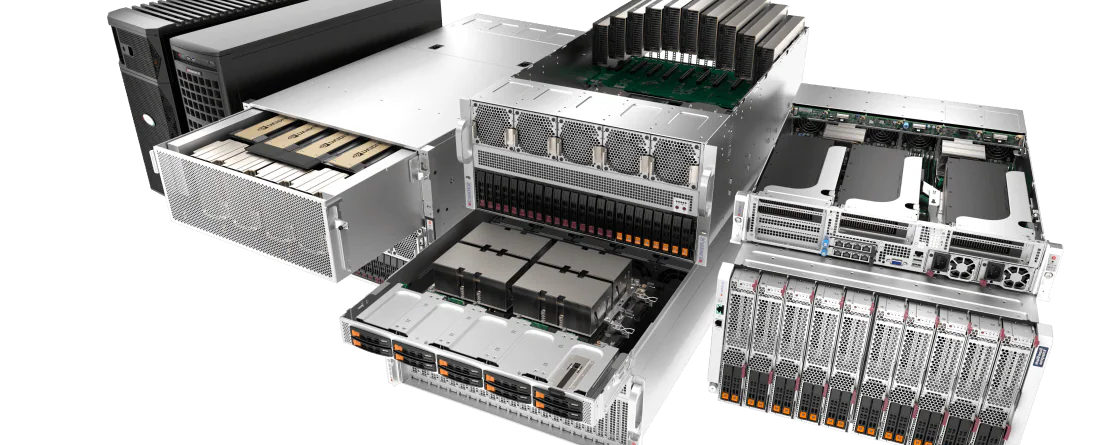
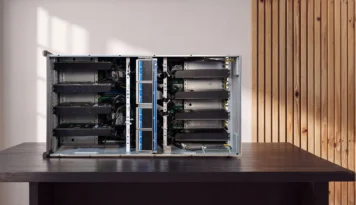
Short answer: An NVIDIA B300 server is a rack-scale AI system built for large-model training, high-throughput inference and HPC. A typical HGX B300 platform uses eight Blackwell Ultra GPUs connected through fifth-generation NVLink and NVSwitch, with up to 2.3 TB of aggregate HBM3e memory. It is not a drop-in replacement for a conventional PCIe GPU server: buyers must plan power, liquid cooling, networking, storage and facility capacity as one system.
What Is an NVIDIA B300 Server?
The term “B300 server” usually refers to a server built around the NVIDIA HGX B300 baseboard. NVIDIA describes HGX B300 as an eight-GPU platform for large language models, traditional deep-learning inference and high-performance computing. Each B300 GPU provides 288 GB of HBM3e, giving an eight-GPU node up to 2,304 GB of GPU memory. That capacity is the defining advantage for models and datasets that cannot fit comfortably on smaller accelerators.
B300 should not be confused with GB300 NVL72. HGX B300 is an eight-GPU server platform; GB300 NVL72 is a liquid-cooled rack-scale design integrating 72 Blackwell Ultra GPUs and 36 Grace CPUs. The correct choice depends on workload scale, software architecture and facility readiness—not simply which name is newer.
Key B300 Server Specifications
| Planning item | HGX B300 | Why it matters |
|---|---|---|
| GPU configuration | 8 NVIDIA B300 GPUs | Designed for tightly coupled multi-GPU workloads |
| Memory per GPU | 288 GB HBM3e | Supports larger models, batches and context windows |
| Memory per node | Up to 2.3 TB | Reduces model partitioning pressure |
| GPU memory bandwidth | Up to 8 TB/s per GPU | Important for memory-bound training and inference |
| GPU interconnect | 5th-generation NVLink and NVSwitch | Enables fast GPU-to-GPU communication |
| Network design | High-speed fabric; architecture-dependent | Cluster performance depends on east-west bandwidth |
These figures are based on current NVIDIA HGX AI Factory documentation. Final server specifications vary by OEM, CPU choice, storage, NICs, firmware and cooling design.
B300 vs H200: The Practical Difference
H200 remains a capable Hopper-generation accelerator with 141 GB of HBM3e and 4.8 TB/s of memory bandwidth per GPU. B300 increases memory capacity substantially and adds the Blackwell Ultra architecture, newer Tensor Core capabilities and a faster scale-up fabric. For organizations running very large models, long-context reasoning or dense multi-GPU jobs, the additional memory can reduce offloading and communication overhead.
That does not make B300 the automatic answer for every AI team. H200 may be easier to source, easier to integrate into an established Hopper software environment and more appropriate when a workload already fits within its memory envelope. The right evaluation compares time-to-solution, utilization, facility cost and software maturity—not peak specifications alone.
Workloads That Benefit Most
- Large-model training: workloads that require high aggregate memory and fast all-to-all communication.
- AI reasoning and long-context inference: services where KV cache, batch size and context length create memory pressure.
- Scientific computing: simulations and data pipelines that scale across tightly connected GPUs.
- Private AI infrastructure: enterprises that need dedicated capacity, predictable access and control over data placement.
- GPU cloud platforms: operators building high-value multi-GPU instances for customers.
Power and Cooling Are Part of the Purchase
A B300 quote is only the beginning of the deployment plan. Eight high-power accelerators, CPUs, memory, networking and storage create a dense thermal load. Buyers should confirm the server’s exact maximum input power, voltage, connector requirements, cooling method and rack-unit height with the system manufacturer. Many B300-class systems require direct liquid cooling or a facility design built for high-density equipment.
Before ordering, ask the hosting provider to validate available power per rack, circuit redundancy, cooling-loop compatibility, water temperature requirements, leak detection, rack weight and service access. A server that cannot be energized and cooled at the destination is inventory, not infrastructure.
Networking and Storage Checklist
Inside the node, NVLink and NVSwitch handle scale-up GPU communication. Between nodes, the cluster needs a scale-out fabric sized for the training or inference pattern. A serious design review should cover NIC count, port speed, topology, oversubscription, RDMA support, switch availability and cable design. Storage must also feed the GPUs consistently; capacity without sufficient read throughput can leave expensive accelerators waiting for data.
- Define single-node versus multi-node workloads.
- Estimate east-west traffic and checkpoint frequency.
- Separate management, storage and compute networks where appropriate.
- Plan local NVMe for caching and shared storage for datasets and checkpoints.
- Confirm out-of-band management and secure remote access.
Questions to Ask Before Buying
- Which exact OEM system and B300 configuration is being quoted?
- Is cooling air, liquid-to-air or direct liquid cooling?
- What are maximum and typical input-power requirements?
- Which CPUs, system memory, NVMe drives and network adapters are included?
- Are optics, cables, rails, PDUs and liquid-cooling components included?
- What firmware and software stack will be validated before delivery?
- Can the destination facility support the density and service requirements?
- Who handles installation, burn-in, remote hands and replacement logistics?
B300 Server Hosting in the United States
For teams that do not operate a high-density data center, colocation can shorten the path from hardware purchase to production. Desert Eagle AI helps customers plan GPU server acquisition, U.S.-based hosting, network connectivity and on-site deployment support. Single-server projects are welcome, while larger clusters can be reviewed around actual power, cooling and network requirements.
Frequently Asked Questions
How much GPU memory does an HGX B300 server have?
An eight-GPU HGX B300 node can provide up to 2,304 GB, or about 2.3 TB, of HBM3e memory.
Is B300 the same as GB300 NVL72?
No. HGX B300 is an eight-GPU server platform. GB300 NVL72 is a rack-scale system with 72 Blackwell Ultra GPUs and Grace CPUs.
Can a B300 server use standard colocation?
Only if the facility supports the system’s verified power density, cooling method, rack requirements and network design. Confirm these items before shipment.
Should I buy B300 or H200?
Choose B300 when memory capacity, Blackwell Ultra features and next-generation scale-up performance justify the infrastructure cost. H200 can remain a strong fit for Hopper-optimized workloads and deployments with lower facility complexity.
Planning a B300 deployment? Share your server, power, cooling and network requirements with Desert Eagle AI.
Leave a Reply