
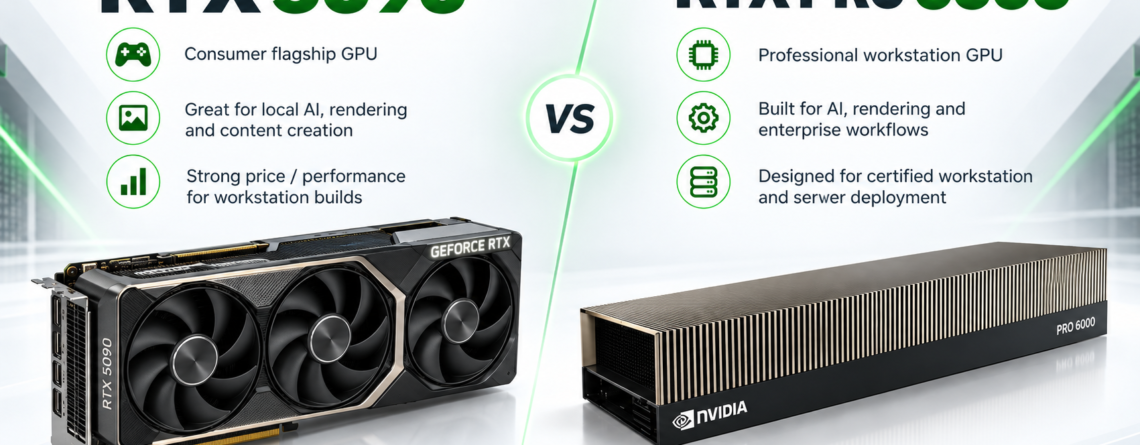
Short answer: RTX 5090 is a high-performance consumer GPU with 32 GB of GDDR7 memory and strong value for an individual AI workstation. RTX PRO 6000 Blackwell offers 96 GB of ECC GDDR7, professional drivers and server/workstation options for larger models, enterprise reliability and multi-user production.
Memory Is the First Decision
The RTX 5090 provides 32 GB of GDDR7, while RTX PRO 6000 Blackwell provides 96 GB. For local AI, memory capacity often matters more than peak gaming performance. A model that does not fit comfortably may require quantization, CPU offload or multiple GPUs, each of which changes performance and complexity.
RTX 5090 Strengths
- Strong performance per dollar for a personal workstation.
- Suitable for development, inference, image generation and many rendering jobs.
- Broad ecosystem support and easy access to desktop tools.
- 32 GB memory can handle many quantized LLMs and creative AI workflows.
The tradeoff is that GeForce is a consumer product. For continuous server duty, buyers must review warranty terms, cooling, remote management, driver requirements and chassis compatibility. The reference RTX 5090 has 575 W total graphics power, so power delivery and airflow still need careful planning.
RTX PRO 6000 Strengths
- 96 GB ECC GDDR7 for larger models and datasets.
- Professional drivers and enterprise software support.
- Server Edition choices for rack deployments.
- Strong AI, ray tracing, video encode/decode and visualization capability.
- MIG support for isolated workloads in supported environments.
RTX PRO 6000 costs more, but its value comes from memory capacity, supportability and deployment features rather than consumer benchmark scores alone.
Workstation Versus Server
A workstation is ideal when one person needs local access, displays, quiet operation and interactive applications. A rack server is better when multiple users connect remotely, GPUs run continuously or the system requires redundant power, remote management and data-center networking. Avoid installing a desktop-style system in a rack without checking physical, cooling and operational requirements.
AI and Rendering Scenarios
Choose RTX 5090 for prototyping, Stable Diffusion, smaller or quantized LLM inference, Blender and individual content-creation workflows where budget matters. Choose RTX PRO 6000 when 32 GB is insufficient, ECC memory is important, professional application certification matters, or the system will serve multiple users and production workloads.
Specification Snapshot
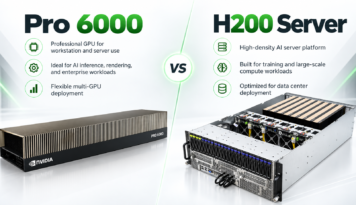
| Feature | RTX 5090 | RTX PRO 6000 Blackwell |
|---|---|---|
| Memory | 32 GB GDDR7 | 96 GB ECC GDDR7 |
| Architecture | Blackwell | Blackwell |
| Positioning | Consumer desktop | Professional workstation/server |
| Best fit | Individual development and creation | Large models and production workloads |
Total Cost Questions
Include the full platform: CPU, system RAM, motherboard lanes, storage, power supply, cooling, chassis and support. For hosted equipment, include rack units, circuit size, bandwidth and remote hands. A cheaper GPU can become expensive if the workload needs multiple cards or frequent operational intervention.
Practical Recommendation
- Start with model and dataset memory requirements.
- Check application certification and driver needs.
- Estimate sustained utilization and duty cycle.
- Decide whether local desktop access or remote multi-user access is required.
- Benchmark a representative workflow before scaling.
Desert Eagle AI Deployment Support
Desert Eagle AI supplies and hosts GPU systems in the United States. We can support a single GPU workstation, a rack server or a growing cluster with colocation, network planning and remote hands. Tell us your applications, preferred GPU, memory requirement and operating model, and we can help compare the practical options.
Contact Desert Eagle AI for a GPU workstation or server deployment review.

Leave a Reply