
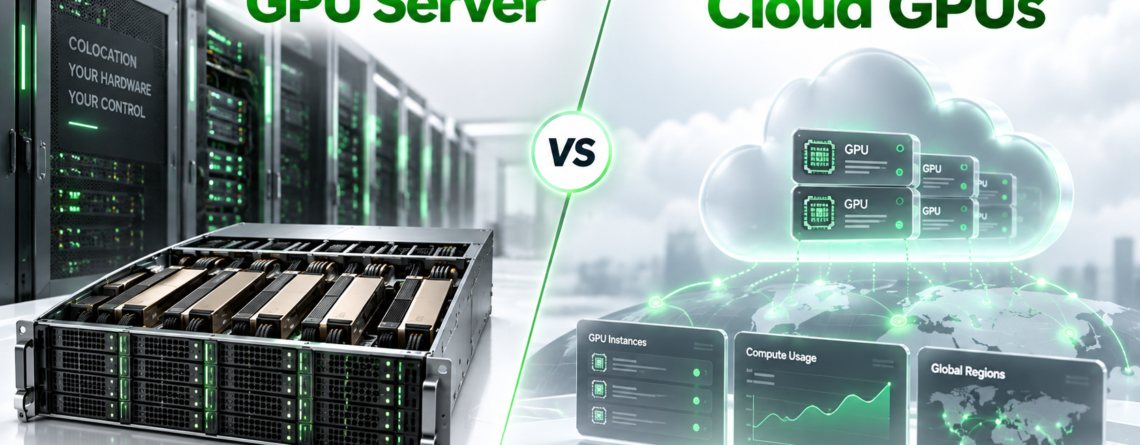
Short answer: Rent cloud GPUs when demand is short-term, uncertain or highly variable. Buy a GPU server when utilization is steady, hardware control matters and the system will run long enough to justify ownership. Colocation provides a middle path: you own the server while a U.S. facility supplies rack space, power, network and on-site support.
The Real Question Is Utilization
An hourly cloud price looks simple, but the buying decision depends on how many hours the GPUs produce useful work. Cloud is efficient when instances can be stopped. Ownership becomes attractive when a server is continuously occupied by training, inference, rendering or customer workloads. A realistic calculation uses expected utilization, not 100 percent on paper.
When Renting Cloud GPUs Makes Sense
- You need capacity immediately for a short project.
- The required GPU model changes frequently.
- Demand has large peaks and long idle periods.
- Your team does not want to operate hardware.
- You need access in several regions or temporary cluster scale.
Cloud also reduces initial capital spending. The tradeoff is continuing operating expense, capacity availability, egress charges, storage fees and less control over the physical platform.
When Buying a GPU Server Makes Sense
- Training or inference runs continuously.
- You need predictable access to a specific GPU configuration.
- Data governance or performance requires dedicated hardware.
- You want to customize storage, networking or system software.
- You can spread the purchase across a multi-year workload.
Ownership does not mean the server is free after purchase. Budget for financing, warranty, colocation, electricity, bandwidth, remote hands, replacement parts and administration.
A Practical Cost Model
Compare both options over the same period. For cloud, include GPU instance hours, attached CPU and RAM, storage, snapshots, network egress, support and reserved-capacity commitments. For ownership, include purchase price, financing, rack space, power, bandwidth, software, insurance, spare parts and expected resale value.
Then calculate cost per productive GPU hour. If a purchased server is idle, its cost per useful hour rises quickly. If a cloud instance remains running around the clock, the flexibility premium can become expensive.
What Colocation Changes
Colocation separates hardware ownership from facility operation. The customer buys the GPU server, and the data center provides physical space, electrical power, cooling and connectivity. Remote hands can assist with installation, cable changes, reboots and basic component work.
This model is useful for AI companies that want dedicated hardware but do not want high-power servers in an office. It also makes it possible to start with one server and add capacity as customer demand grows.
Control and Performance
Owned hardware gives the operator direct control over firmware, drivers, operating system, storage layout and scheduling. That can improve consistency and simplify performance tuning. Cloud platforms offer automation and fast provisioning, but exact hardware revisions, contention policies and availability may vary.
For sensitive data, evaluate encryption, access controls, audit requirements and data location under both models. Dedicated hardware can reduce some sharing concerns, but security still depends on correct system and network operation.
Hybrid Strategy
Many teams should not choose only one model. A common approach is to own baseline capacity for steady workloads and rent cloud GPUs for peaks, experiments or geographic expansion. This keeps core utilization on predictable infrastructure while preserving elasticity.
Questions Before You Decide
- How many GPU hours do we use per month today?
- How variable is demand?
- Which GPU memory capacity and interconnect do our models require?
- What are storage and egress costs?
- Who will manage drivers, monitoring and failures?
- Can the workload use a hybrid queue?
- What is the expected hardware life and resale value?
Example Decision Pattern
A startup running occasional fine-tuning may prefer cloud access until demand becomes predictable. A rendering studio with a full production queue may lower long-term cost through owned GPUs. A GPU cloud or MSP with committed customers may buy servers and colocate them, while retaining public-cloud capacity for overflow.
How Desert Eagle AI Can Help
Desert Eagle AI helps customers compare GPU server ownership, colocation and managed hosting in the United States. We support single-server deployments and growing clusters, with planning around power, network, rack requirements and remote hands.
Send us your GPU type, workload and monthly utilization, and we can help structure a practical buy-versus-rent comparison.
Leave a Reply